The Science of Macronutrients: Stop Guessing What You Eat
Published on May 11, 2026 Updated
I will never forget the first time I walked into a premium sports supplement store. There were massive black tubs of powder everywhere with aggressive names like "Anabolic Mass Gainer," "Shred Matrix," and "Nitro-Tech." I was overwhelmed, confused, and felt entirely out of my depth. I just wanted to lose my belly fat and build some visible muscle, but the fitness industry made it seem like I needed a degree in biochemistry to achieve it.
For months, I tried the generic advice: "Just eat clean." I ate salads, brown rice, and almonds. I felt healthier, but my body shape wasn't changing. It wasn't until I stopped trusting vague advice and started trusting the hard, mathematical science of macronutrients that my physique actually transformed.
Why "Eating Clean" is a Flawed Strategy
Here is the brutal truth that most fitness influencers will not tell you: You can eat nothing but organic avocados, quinoa, and cold-pressed olive oil, and you will still gain massive amounts of fat if you eat too much of it. Your body does not care how expensive or "organic" a calorie is; if there is an excess of energy, it will store it as fat.
Conversely, you can lose weight eating absolutely nothing but pizza and ice cream, provided you eat less total calories than your body burns (your TDEE). I do not recommend this, as you will feel terrible and lose muscle mass, but thermodynamically, it is true. This is why you must move away from "eating clean" and move toward "tracking macros."
The Big Three: Protein, Carbs, and Fats
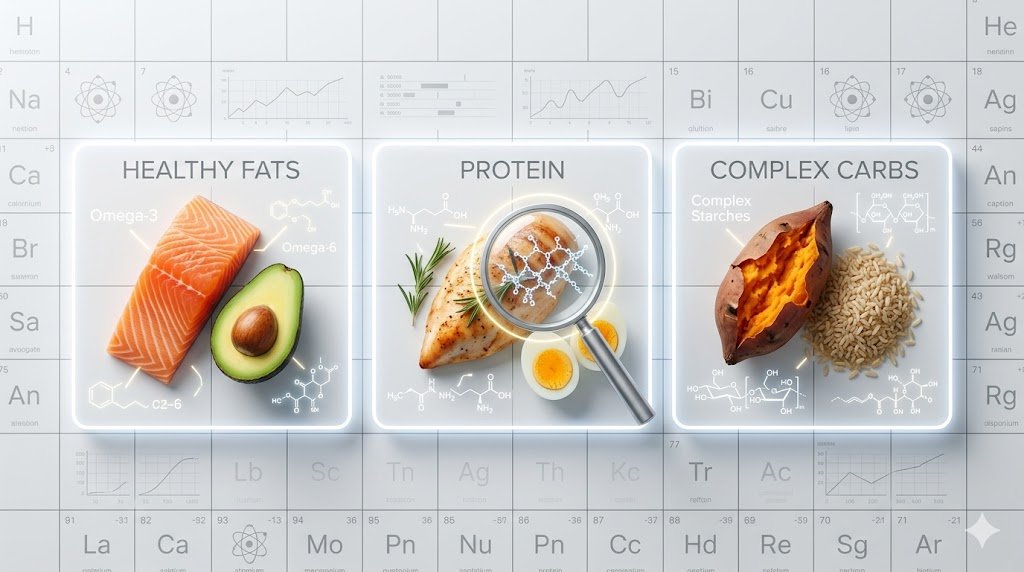
Every piece of food you eat is made up of three primary macronutrients. Understanding what they do is the key to manipulating your body composition.
Protein (4 calories per gram): The Architect
Protein is the most critical macro for changing how you look. When you lift weights, you tear your muscle fibers. Protein is the brick and mortar your body uses to rebuild those fibers bigger and stronger. Furthermore, protein is highly satiating (it keeps you full) and has a high Thermic Effect—meaning your body burns more calories just digesting protein than it does digesting carbs or fat. If you want to look lean and athletic, a high-protein diet is non-negotiable.
Carbohydrates (4 calories per gram): The Fuel
Carbs are not evil. Despite what the Keto community claims, your brain and your muscles prefer carbohydrates as their primary energy source. If you want to perform intensely in the gym, run fast, or focus deeply on a coding project, you need carbs. The trick is to eat complex carbs (like oats or sweet potatoes) that release energy slowly, rather than simple sugars that spike your insulin and cause an energy crash.
Fats (9 calories per gram): The Regulator
Fats are incredibly dense, containing more than double the calories per gram of protein or carbs. This makes them very easy to overeat (which is why a handful of almonds is surprisingly high in calories). However, you cannot eliminate them. Dietary fats are essential for regulating your hormones, particularly testosterone and estrogen. Without sufficient fat intake, your hormonal health will crash.
How to Set Your Macro Baseline
Calculating the perfect ratio of these three nutrients manually is a nightmare. That is exactly why the Macro Calculator is the most used tool in my personal fitness arsenal. Here is how I use it to engineer my diet:
- Establish the Calorie Target: I use the tool to find my maintenance calories (TDEE). If I want to lose fat, I set the tool to a 400-calorie deficit. Let's assume my target is 2,000 calories.
- Lock in the Protein: The tool automatically calculates my protein needs based on my body weight (usually around 2 grams per kilogram). Let's say my target is 150g of protein. That accounts for 600 calories (150g x 4). I have 1,400 calories left.
- Lock in the Fat: The tool ensures I get enough fat for hormonal health, usually around 25% of my total calories. Let's say 55g of fat. That accounts for roughly 500 calories (55g x 9). I have 900 calories left.
- Fill the Rest with Carbs: The remaining 900 calories are assigned to carbohydrates (roughly 225g of carbs).
Now I have a mathematically perfect blueprint: 150g Protein, 55g Fat, 225g Carbs. I don't guess anymore. I just use an app to track my food until I hit those numbers.
Final Thoughts
Taking control of your nutrition is incredibly empowering. You stop being afraid of food. You realize that a slice of pizza isn't going to ruin your progress if it fits into your daily macro targets. Use the calculator, find your numbers, buy a food scale, and commit to tracking your food honestly for just 30 days. It will completely change how you view your body and your diet.

Written by Rishav
Founder & Lead Developer
Rishav is an independent software developer and financial enthusiast based in India. He built CalculiX Pro to combat the cluttered, ad-heavy landscape of utility websites and provide users with privacy-first, instant mathematical answers. When not coding, he writes about personal finance, algorithmic logic, and web architecture.
Read more about the mission